CodeEvolver
Small, local models that find security flaws in code, cite the weakness they break, and suggest the fix.
Security flaws such as SQL injection are easy to write and easy to miss, especially for students and early-career developers. Static analysers flag patterns without explaining them, and general-purpose AI assistants can explain but require sending code to a third-party service and rarely ground their advice in an accepted standard.
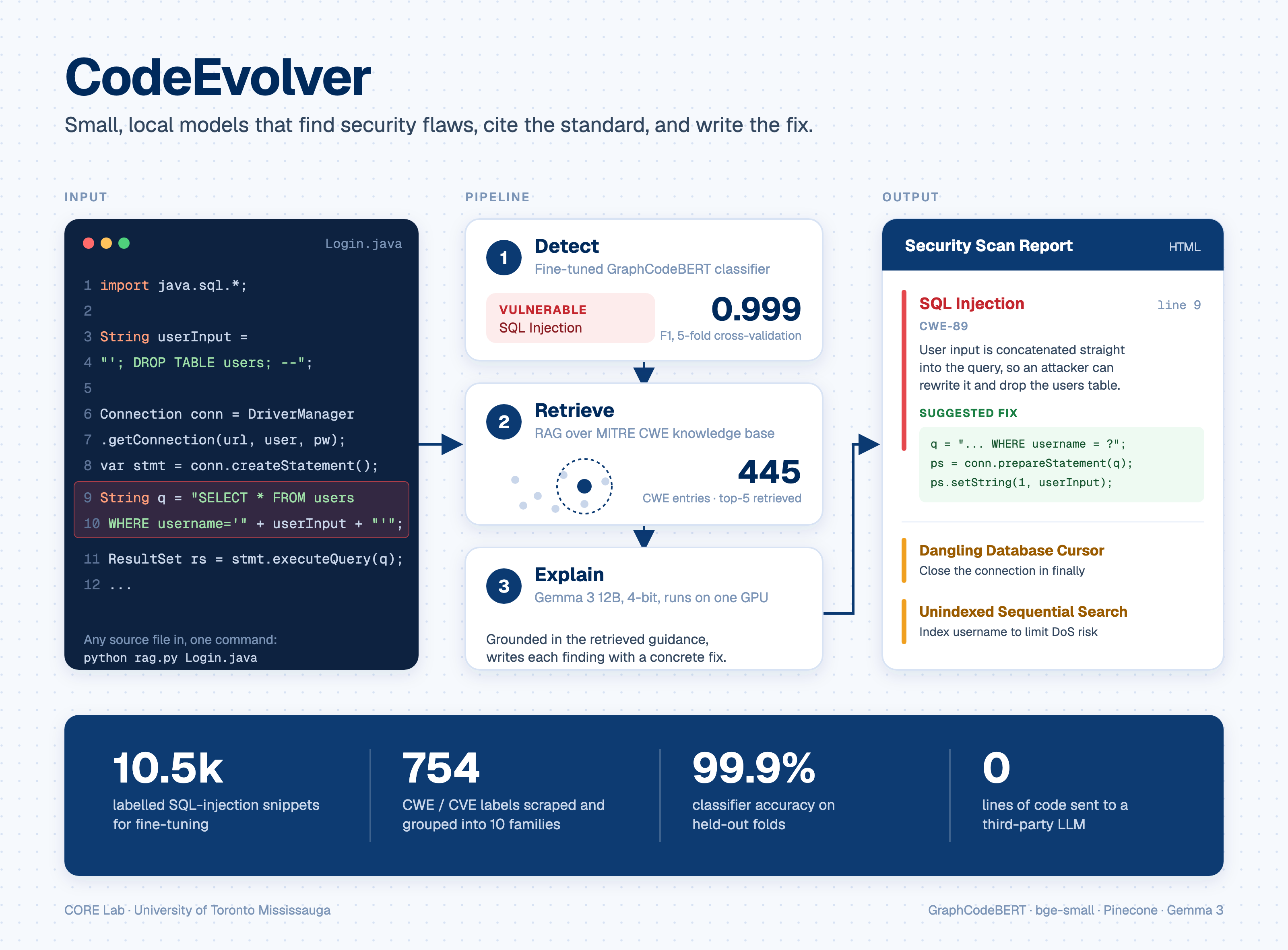
CodeEvolver reviews a source file in three stages, using only small models that run on a single GPU. A GraphCodeBERT model, fine-tuned on labelled vulnerable and safe code, decides whether the file contains a given class of vulnerability. If it does, a retrieval-augmented generation step pulls the most relevant entries from a knowledge base of MITRE CWE records. Gemma 3 12B, quantised to 4-bit, then writes an HTML report: the line, the offending snippet, an explanation, and a suggested fix.
The team scraped 754 CWE and CVE vulnerability labels and grouped them into 10 families, from memory-bounds errors to injection and access-control flaws. The first classifier, trained on about 10,500 SQL-injection snippets, reached 0.999 F1 in five-fold cross-validation. Current work extends the classifiers to the remaining families, removes duplicate findings from reports, and benchmarks the pipeline against frontier language models.
People



Papers
Papers will appear here as the project publishes.