VoiceEx
Exploring how voice-based reflection can make self-explanation more natural, expressive, and effective for learners.
Explaining an idea in their own words deepens students’ understanding of it, but many students struggle to reflect or self-explain effectively. In flipped courses, where students prepare before class, the lab’s early work found that students who reflected on lecture concepts did better on the homework that covered them and on later assessments.
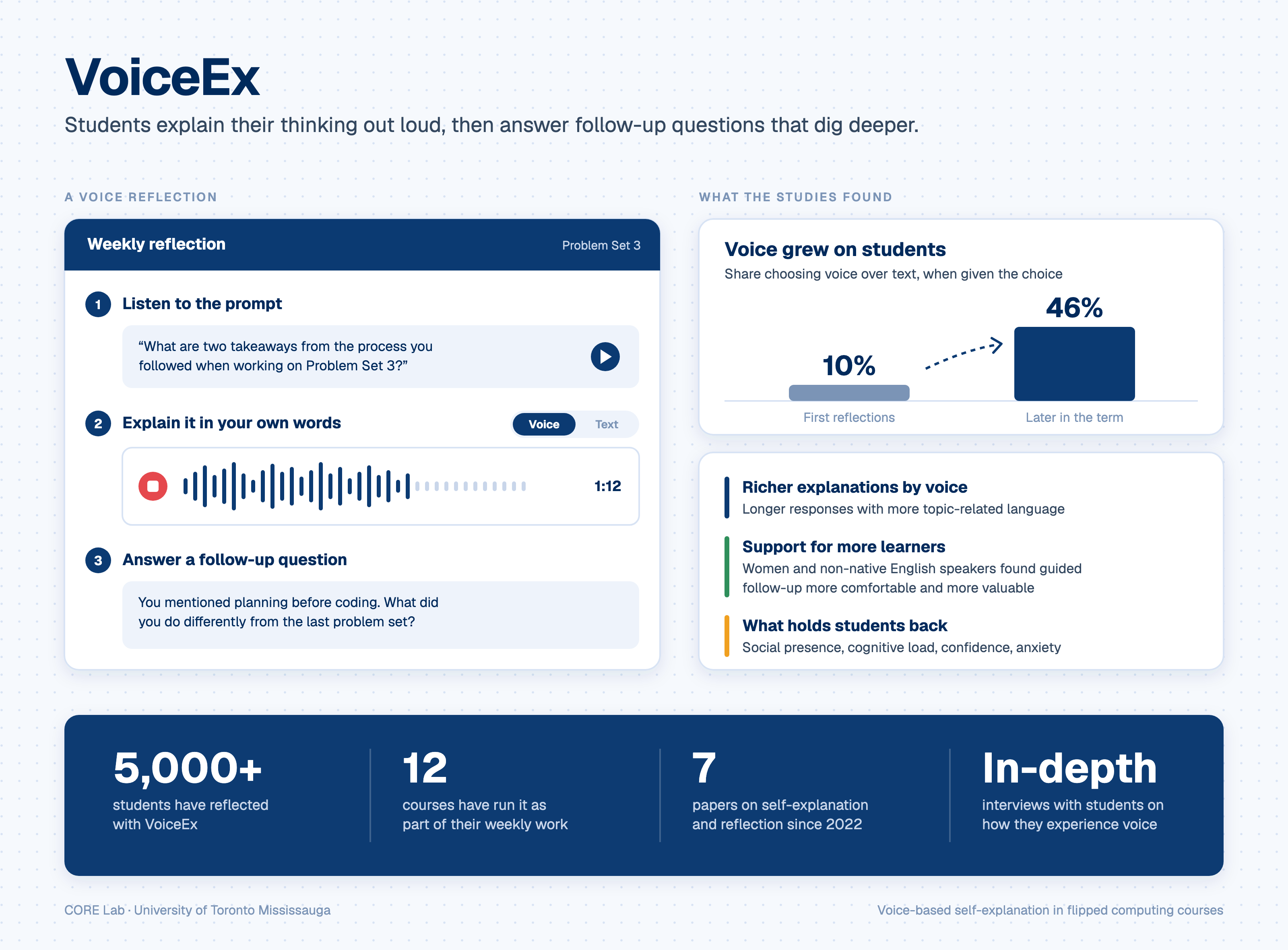
VoiceEx supports self-explanation in flipped computing courses. Students can listen to a reflection prompt, record or upload a spoken response, and continue with guided follow-up questions that encourage them to examine how they approached a problem and where their understanding could improve. It has been used by more than 5,000 students across 12 courses.
The research behind VoiceEx compares voice and text as reflection media. In a field study with 247 students, most initially preferred text, but voice responses were longer and contained more topic-related language, and among students given a choice, the share choosing voice rose from 10% to 46% over time. Interviews showed how social presence, confidence, cognitive load, and performance anxiety shape that choice, pointing toward tools that let students mix voice and text. A later study added LLM-guided follow-up that helps students find gaps in their explanations; women and non-native English speakers reported greater comfort with it and found it more valuable.
People
CORE Lab
- Angela Zavaleta BernuyCo-Director, CORE Lab; Assistant Professor, Computing and Software, McMaster University
- Naaz SibiaPh.D. Candidate, Computer Science, University of Toronto
- Harry (Runlong) YePh.D. Student, Computer Science, University of Toronto
- Jessica WenUndergraduate Researcher, University of Toronto Mississauga
- Michael LiutCo-Director, CORE Lab; Associate Professor, Teaching Stream, University of Toronto Mississauga


Collaborators

Papers
- Jessica Wen, Angela Zavaleta Bernuy, Naaz Sibia, Andrew Petersen, Michael Liut."Enhancing Self-Explanation in Student Learning Through Large Language Models" Proceedings of the 30th ACM Conference on Innovation and Technology in Computer Science Education V. 2. (2025).[doi][]
- Jessica Wen, Bianca Arteaga Alvarez, Jorge Moreno Velasco, Naaz Sibia, Angela Zavaleta Bernuy, Carlos Aníbal Suárez, Andrew Petersen, Michael Liut."Self-Explanations: Does Timing Matter?" Proceedings of the 30th ACM Conference on Innovation and Technology in Computer Science Education V. 2. (2025).[doi][]
- Angela Zavaleta Bernuy, Naaz Sibia, Pan Chen, Jessica Jia-Ni Xu, Elexandra Tran, Runlong Ye, Viktoria Pammer-Schindler, Andrew Petersen, J. Williams, Michael Liut."Does the Medium Matter? An Exploration of Voice-Interaction for Self-Explanations" Proceedings of the 2024 ACM Designing Interactive Systems Conference. (2024).[doi][]
- Naaz Sibia, Angela Zavaleta Bernuy, Elexandra Tran, Jessica Jia-Ni Xu, J. Williams, Andrew Petersen, Michael Liut."Exploring Self-Explanations in a Flipped Database Course" Proceedings of the 3rd International Workshop on Data Systems Education: Bridging education practice with education research. (2024).[doi][]
- Angela Zavaleta Bernuy, Jessica Jia-Ni Xu, Naaz Sibia, J. Williams, Andrew Petersen, Michael Liut."Self-Explanation Modality: Effects on Student Performance?" Proceedings of the 2023 Conference on Innovation and Technology in Computer Science Education V. 2. (2023).[doi][]
- Naaz Sibia, Michael Liut."The Positive Effects of using Reflective Prompts in a Database Course" Proceedings of the 1st International Workshop on Data Systems Education. (2022).[doi][]
- Pan Chen, Naaz Sibia, Angela Zavaleta Bernuy, Michael Liut, J. Williams."Investigating the Impact of Voice Response Options in Surveys" Proceedings of the 53rd ACM Technical Symposium on Computer Science Education V. 2. (2022).[doi][]