Publications
Everything the lab has published or presented, from full papers to conference posters.
Poster Showcase
Posters the lab has presented at conferences. Open one to read it up close, with its abstract and citation.
1 of 6
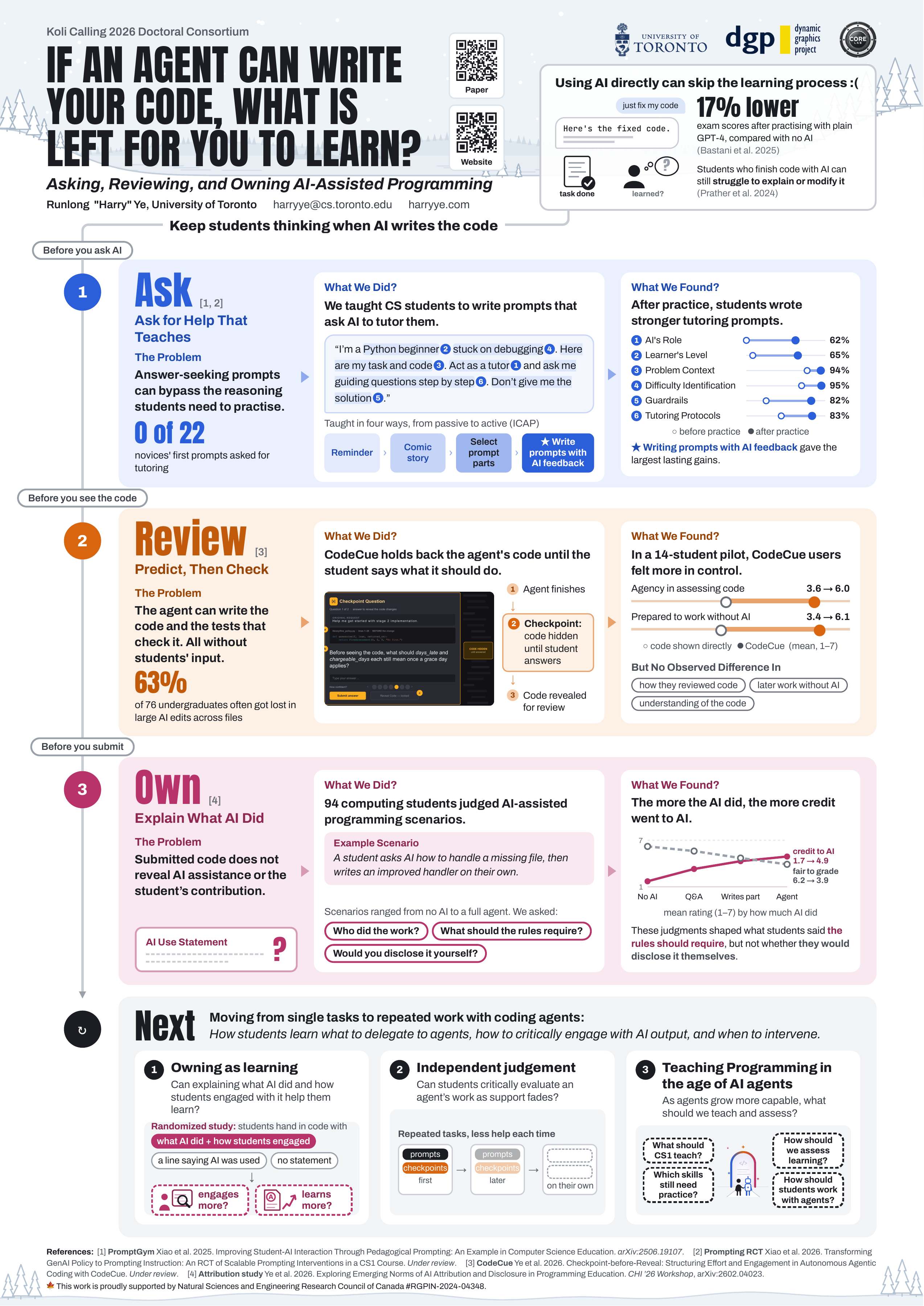
Koli Calling 2026 Doctoral Consortium poster
If an Agent Can Write Your Code, What Is Left for You to Learn? Asking, Reviewing, and Owning AI-Assisted Programming
When a coding agent can produce a program, its tests, and an explanation, the submission says little about what the student understands. My dissertation investigates how computing students can use AI while retaining the reasoning needed to learn programming. I take part in examining three practices: asking for tutoring that requires students to reason, reviewing generated code against expectations formed before seeing it, and owning the work by explaining AI assistance and their own decisions. In two prompting studies, including a randomized trial with 979 CS1 students, students’ tutoring prompts improved after instruction. In CodeCue, predicting program behaviour before seeing an agent’s changes made students feel better prepared, but did not measurably change how they reviewed. Our study on AI attribution found that what students think should be disclosed differs from what they would disclose themselves. The next phase connects these practices, beginning with a randomized attribution study and extending to repeated tasks with gradually reduced support. I will examine how students learn to direct coding agents, evaluate their work, and retain programming understanding that they can apply independently.
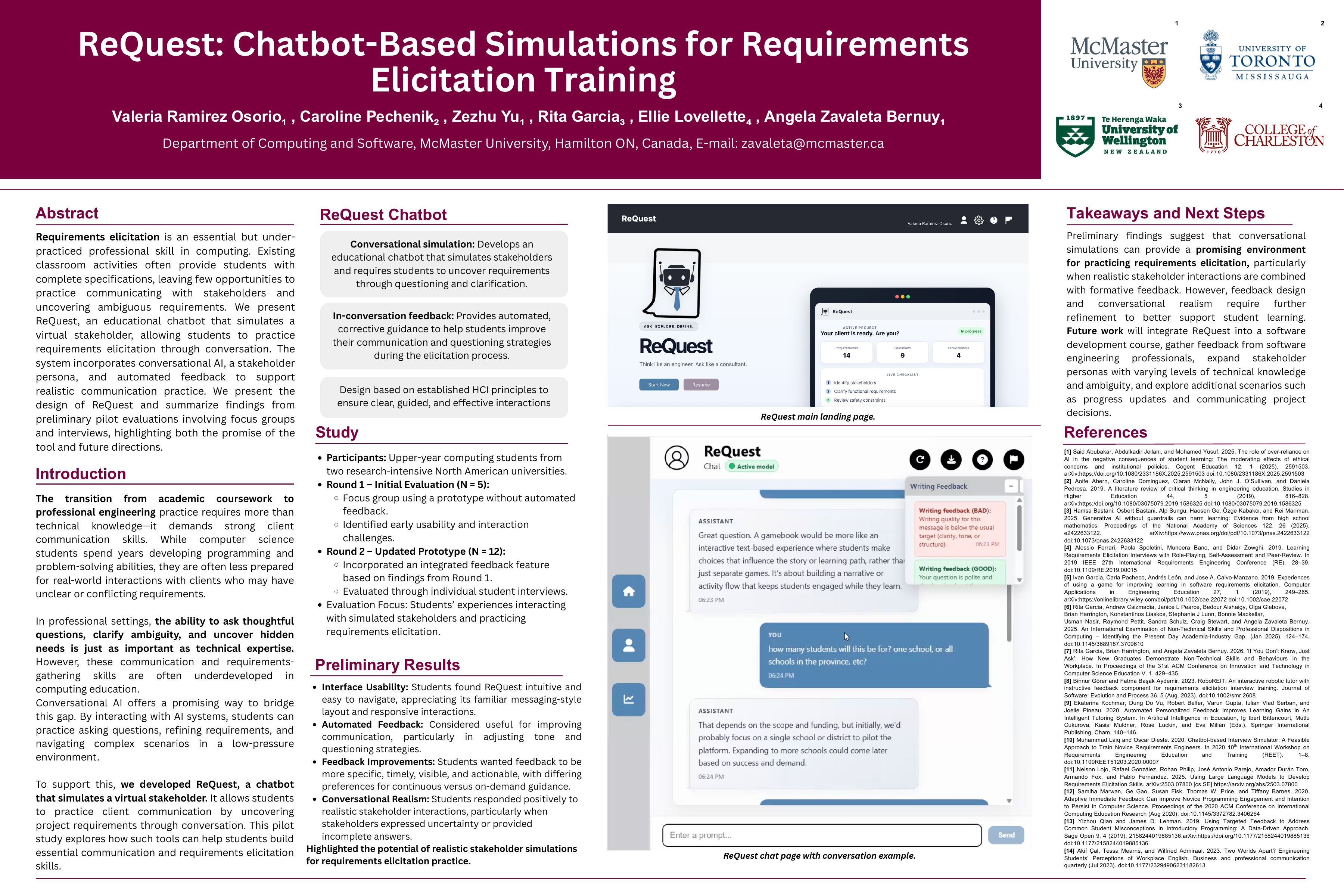
Koli Calling 2026 poster
ReQuest: Chatbot-Based Simulations for Requirements Elicitation Training
Valeria Ramirez Osorio, Caroline Pechenik, Ze-Zhu Yu, Rita Garcia, Ellie Lovellette, Angela Zavaleta Bernuy
Requirements elicitation is an essential but under-practiced professional skill in computing. Existing classroom activities often provide students with complete specifications, leaving few opportunities to practice communicating with stakeholders and uncovering ambiguous requirements. We present ReQuest, an educational chatbot that simulates a virtual stakeholder, allowing students to practice requirements elicitation through conversation. The system incorporates conversational AI, a stakeholder persona, and automated feedback to support realistic communication practice. We present the design of ReQuest and summarize findings from preliminary pilot evaluations involving focus groups and interviews, highlighting both the promise of the tool and future directions.
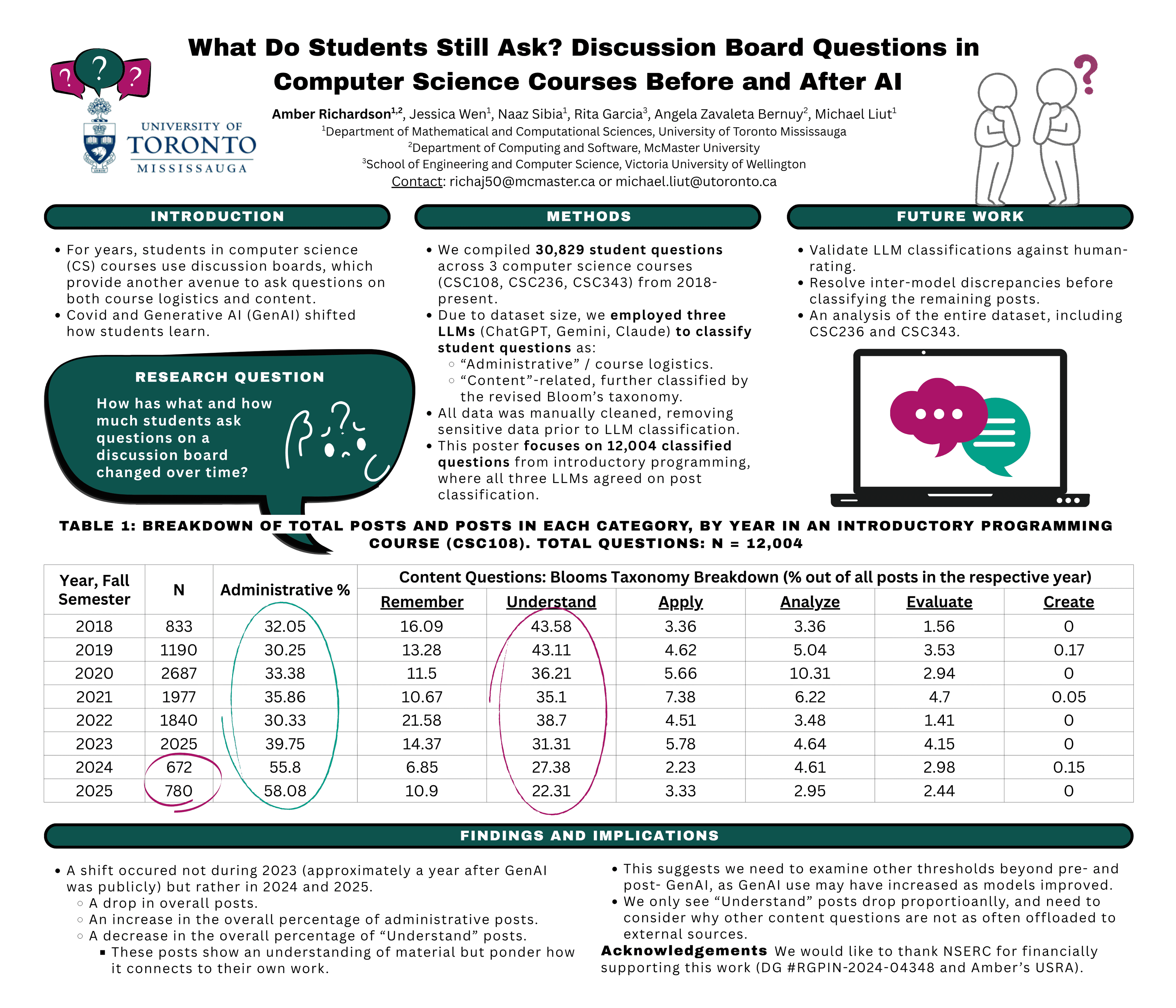
UTM Experiential Education Fair 2026 poster
What Do Students Still Ask? Discussion Board Questions in Computer Science Courses Before and After AI
Amber Richardson, Jessica Wen, Naaz Sibia, Rita Garcia, Angela Zavaleta Bernuy, Michael Liut
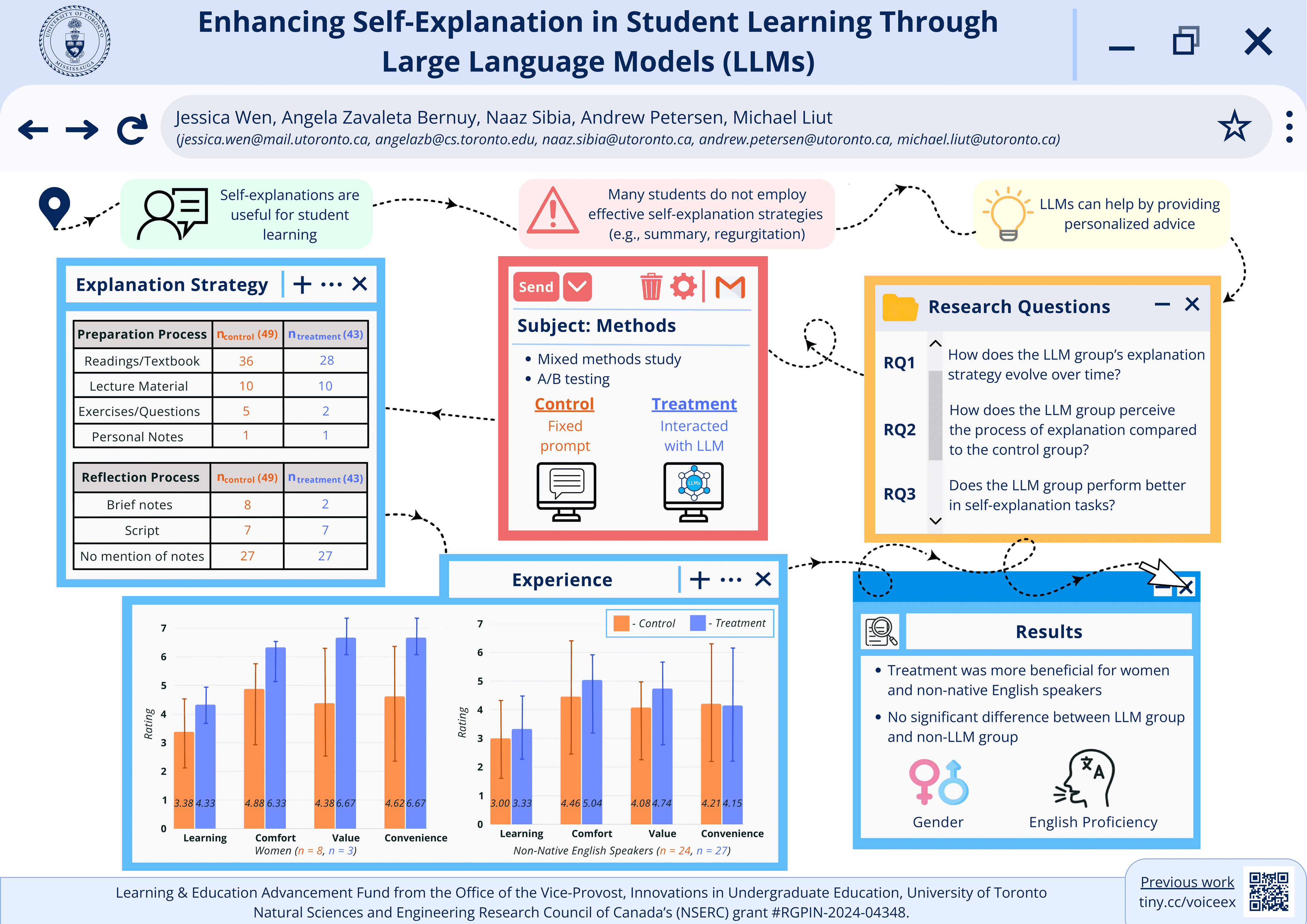
ITiCSE 2025 poster
Enhancing Self-Explanation in Student Learning through Large Language Models
Jessica Wen, Angela Zavaleta Bernuy, Naaz Sibia, Andrew Petersen, Michael Liut
Self-explanation deepens understanding by giving learners an opportunity to reflect on what they are learning in a structured way. However, many students struggle to engage in it effectively. We investigate whether large language models (LLMs) can scaffold self-explanations in a flipped computer organization course. In an A/B test, one group used a fixed prompt to compare their explanations with an expert's, while another engaged in an interactive dialogue with an LLM to identify gaps. Although the overall quality of the explanation did not differ significantly between conditions, some students (non-native English speakers and women) reported greater comfort and perceived value when using the LLM.
ITiCSE 2025 poster
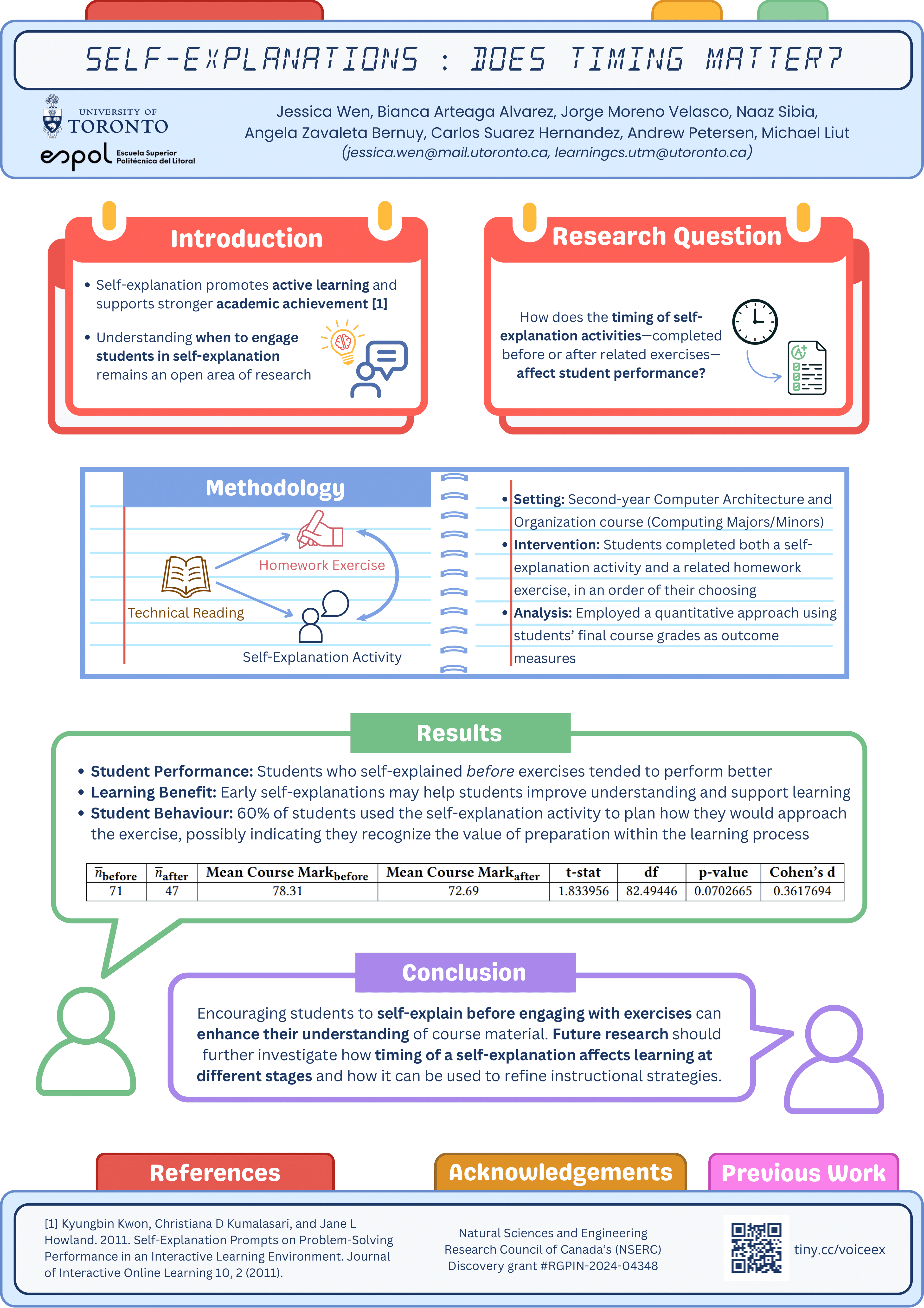
Self-Explanations: Does Timing Matter?
Jessica Wen, Bianca Arteaga Alvarez, Jorge Moreno Velasco, Naaz Sibia, Angela Zavaleta Bernuy, Carlos Aníbal Suárez, Andrew Petersen, Michael Liut
Self-explanation promotes active learning by having students articulate their conceptual understanding in their own words. This study investigates whether the timing of self-explanations (before vs. after solving an exercise) relates to performance in a flipped, second-year computer organization course. Although students who self-explained before the exercises achieved higher course marks, the difference was not significant. Still, these findings suggest that early self-explanation may better prepare students for problem-solving when learning new concepts.
NYGH Teaching and Learning Week 2024 poster
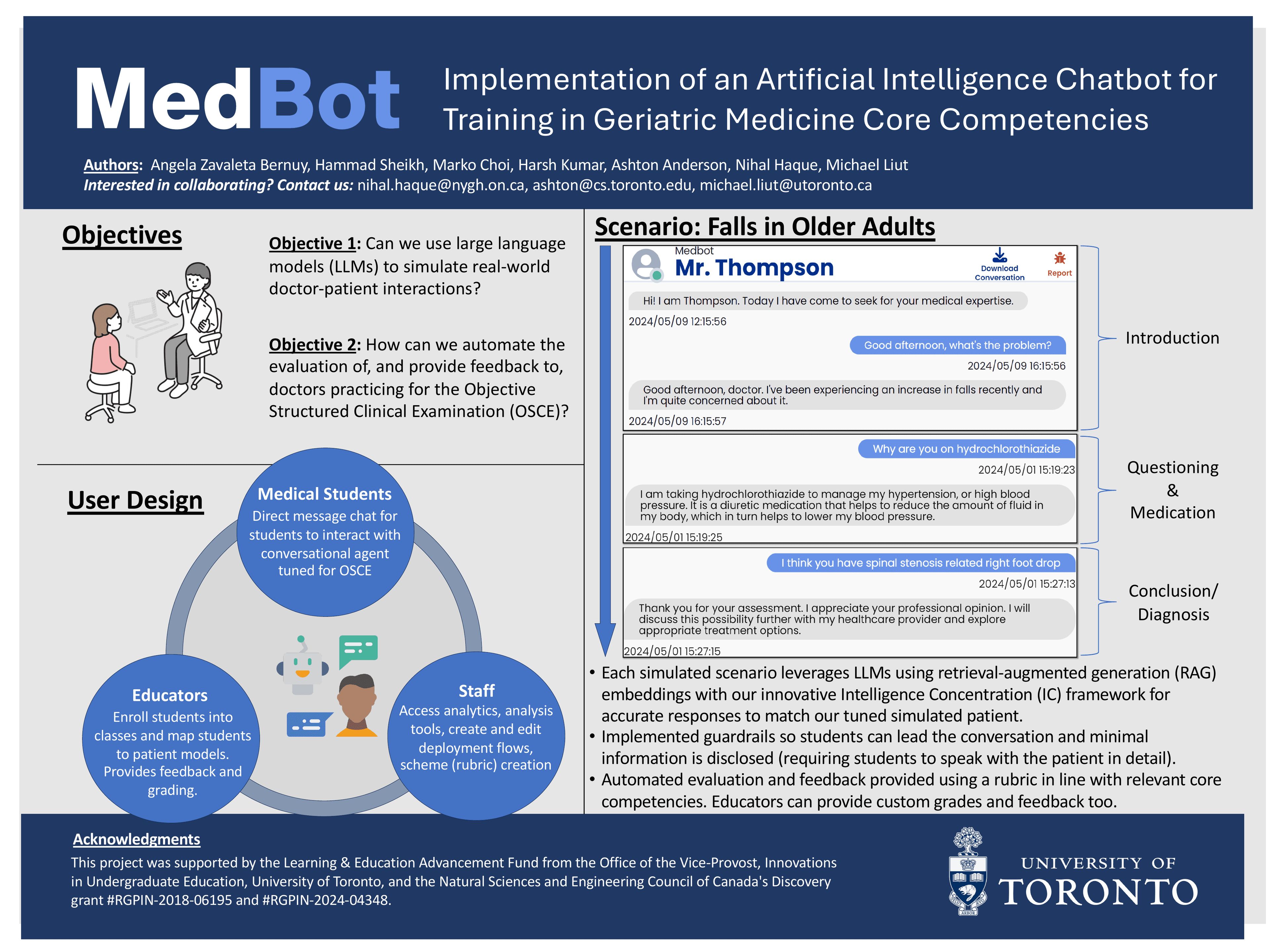
Implementation of an Artificial Intelligence Chatbot for Training in Geriatric Medicine Core Competencies
Angela Zavaleta Bernuy, Hammad Sheikh, Marko Choi, Harsh Kumar, Ashton Anderson, Nihal Haque, Michael Liut